 Just 5min
1
Open it and press start
The timer is already set to five minutes. There is no confirmation step, because a confirmation step is one more chance to talk yourself out of it.
You know exactly what you have to do. You have known since Tuesday. It shrinks the first step until it is too small to argue with — five minutes, one tap, permission to stop when it ends. Most people don’t.
See how it works Take the 60-second procrastination test →
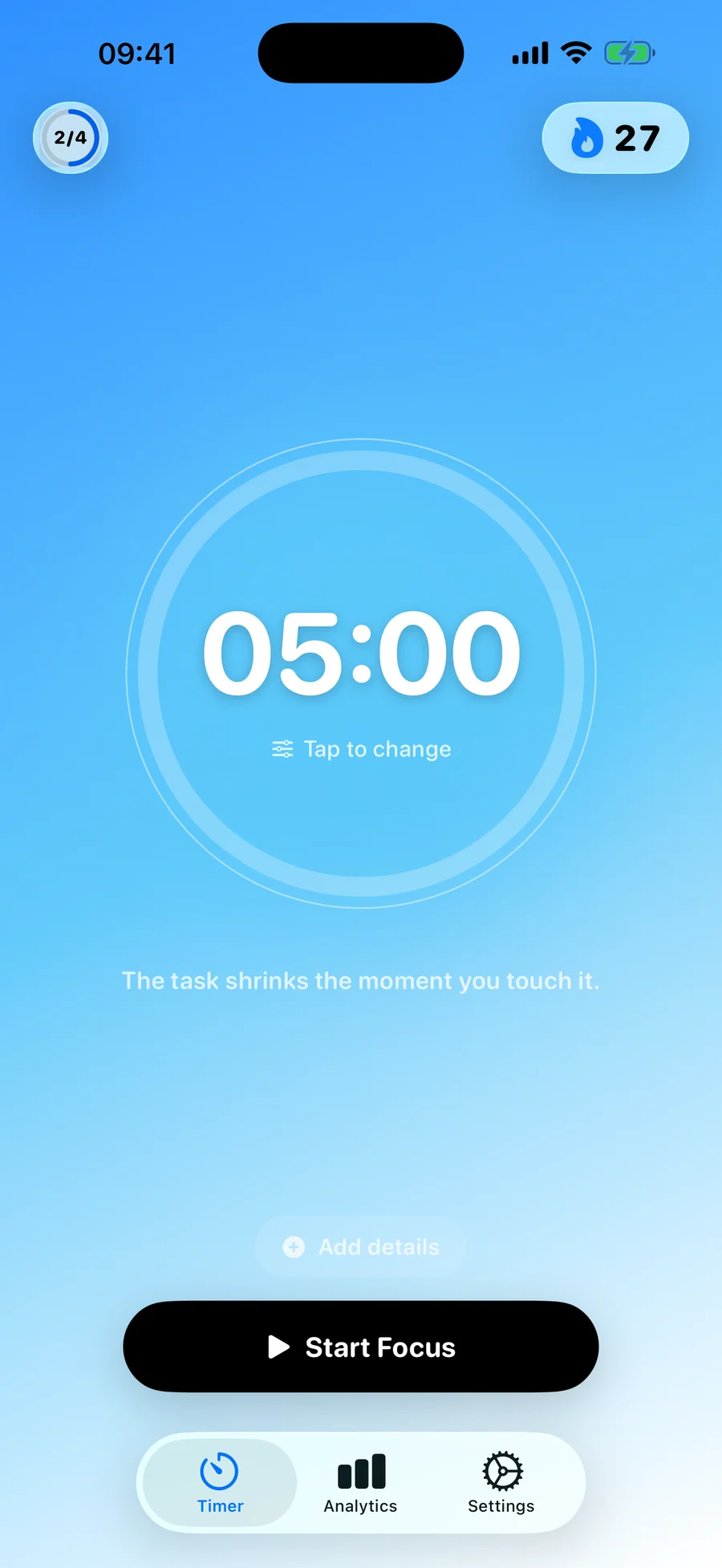
No setup, no projects to configure, no method to learn first. That is the point — every extra decision is another place to quit.
The timer is already set to five minutes. There is no confirmation step, because a confirmation step is one more chance to talk yourself out of it.
The session is anchored to a real finish time, not a counter. Lock the phone, take a call, close the app entirely — it still ends when it was always going to end, and tells you.
When it runs out you have genuinely finished. Most people keep going anyway — but that stays a side effect. The moment five minutes becomes a trick to get an hour, it stops working.
A shield while you work, the pattern behind it, and the proof you showed up. Nothing to configure before the first session.
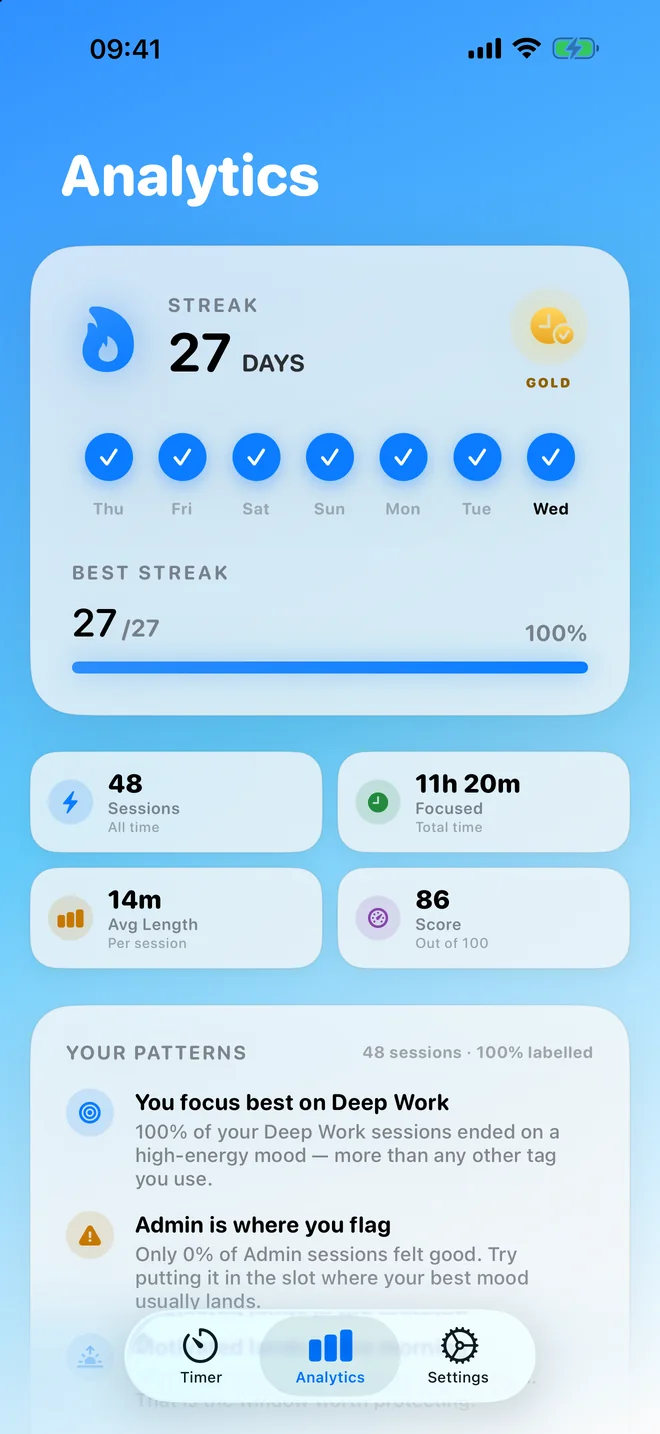
Block the apps you actually reach for, for the length of a session.
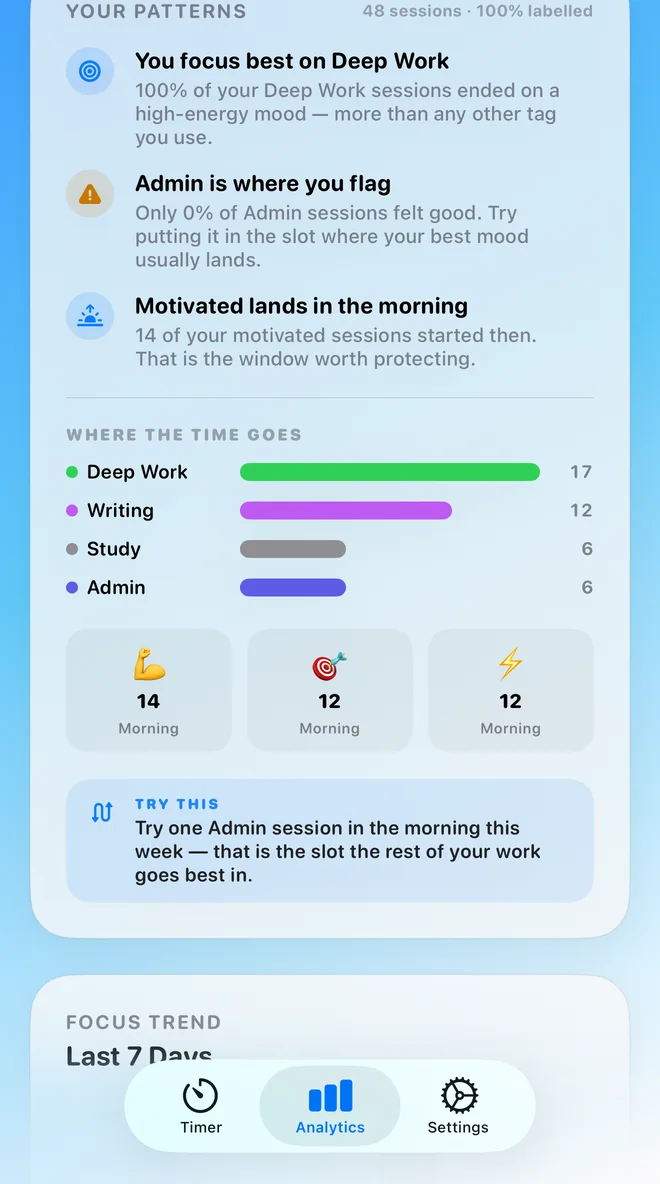
Written from your own sessions: the tag you finish, the one you flag, the hour that works.
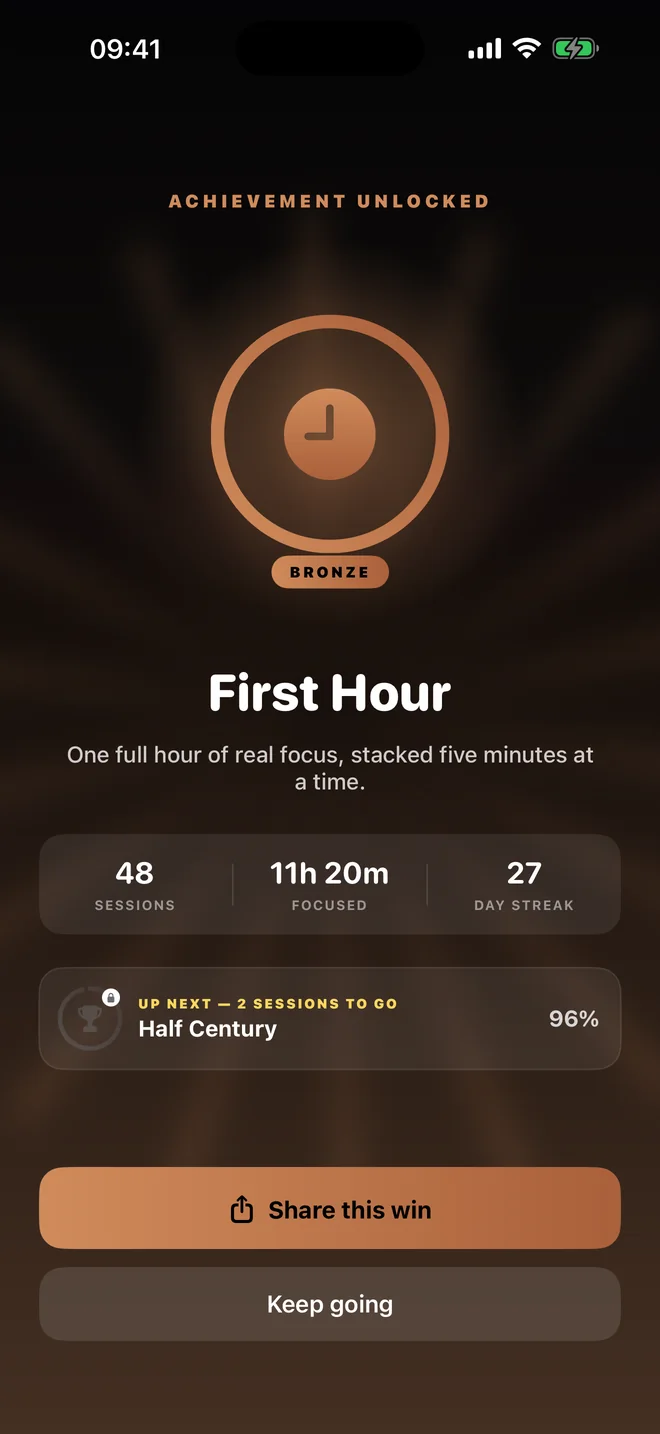
Quiet proof that the small sessions added up to something you would have called real work.
Every feature below exists to remove a specific excuse. Nothing here is a productivity dashboard you will spend an afternoon configuring instead of working.
The length is decided before you arrive, so the session starts instead of becoming a decision about how long to work.
Solves: "I'll start when I have a proper block of time."Block the apps you actually reach for, for the length of a session. Start the timer and the exits are gone until it ends.
Solves: "I started the timer and opened Instagram anyway."Your peak hour, your strongest weekday, the tag you actually finish, and the words that keep coming back in your notes.
Solves: "Generic advice that was written for somebody else."One finished session a day keeps the streak. Miss a day and a freeze absorbs it automatically, and your record is kept permanently either way.
Solves: "I broke the chain on day four, so I gave up."Finished sessions appear as blocks in your calendar, so the time you spent is visible next to the time you booked.
Solves: "My calendar has no idea I did the work."Leave the app, lock the screen, let iOS kill it mid-session. The countdown finishes on time and the session is recorded when you come back.
Solves: "I lost my session, so what was the point."A widget that starts a session without opening the app — so the reflex that reaches for a feed lands on the work instead.
Solves: "I picked up my phone and lost twenty minutes."Attach a mood, a tag and a line of your own before you start. Four seconds, and it turns a pile of sessions into something that can tell you about yourself.
Solves: "I have no idea where my good days come from."No motivational posters. These are the questions typed into Google at 1am, with the answers the research and a decade of self-help mostly agree on. Longer versions live in the guides — the 5-minute rule, why starting is hard, and more.
Procrastination is a mood-repair habit, not a time-management failure. Facing a task produces a small amount of discomfort — boredom, uncertainty, fear of doing it badly — and avoiding it relieves that discomfort immediately. The relief is the reward, so the loop reinforces itself even when you fully understand the cost.
Which is why knowing better does not break it: the loop was never about knowing. What breaks it is shrinking the task until the discomfort of starting drops below the threshold that triggers avoidance. Five minutes is usually below it.
Commit to the task for five minutes only, with explicit permission to stop when the timer runs out. It works because resistance attaches to the size of a task, not to the work itself. Five minutes is too small to argue with, so the negotiation you normally have with yourself never starts.
In practice most people keep going well past the timer. But that has to stay a side effect rather than the goal — the moment five minutes becomes a trick to get you to do an hour, your brain notices, and the resistance comes straight back.
Stop trying to start studying. Start a five-minute timer instead. Pick the single smallest concrete action — open the document, re-read one page, write one bad sentence — press start before you feel ready, and let the timer own the decision.
The trap is planning. A study plan feels productive and quietly postpones the only thing that matters, which is the first minute. Do the five minutes first and plan afterwards, when you are already working and planning costs you nothing.
Because starting and doing use different machinery. Task initiation is an executive function — the same one that struggles with ADHD, exhaustion, stress and depression — and it is largely independent of how difficult the task actually is. That is why you can be perfectly capable of a ten-minute job and still not begin it for three days.
The fix is not motivation, which tends to arrive after action rather than before it. It is lowering the activation cost: a fixed, tiny, pre-decided first step you can take without any deliberation at all.
It works well for sustaining focus and poorly for starting. A 25-minute Pomodoro is still big enough to negotiate with, so somebody who cannot begin at all often cannot begin a Pomodoro either.
If you already start reliably and lose focus midway, Pomodoro is the right tool. If your problem is that the task has sat untouched since Tuesday, begin at five minutes and grow the block later. A 25-minute session you never start is worth nothing; a five-minute one you actually run is worth five minutes plus the momentum.
Short enough that you will start it today. For most people beginning a new habit that is five minutes; on a day you are already warmed up it might be sixty or ninety.
The honest test is not what the research says about attention spans — it is whether you actually pressed start. Track which lengths you complete rather than which ones you schedule, and let the number you finish most often become your default.
Add friction to the phone and remove it from the work. Most phone procrastination is not a decision — it is a reflex reaching for an app you did not consciously choose to open, usually in the exact moment a task gets uncomfortable.
Give that moment somewhere else to go: a timer that starts in one tap, from the Home Screen, so the reflex lands on the work instead of on a feed. Then make the phone slightly harder — move the worst app off the first screen, turn off its badges, and put the phone face down while a session runs.
Laziness is not wanting to do the thing. Procrastination is wanting to do it, intending to do it, and still not starting — which is why it produces guilt and laziness does not.
That distinction matters practically. A lazy person needs a reason; a procrastinating person already has one. Adding more motivation to somebody who is already motivated does nothing at all. Lowering the size of the first step does.
Make the daily requirement small enough to survive a bad day, and make missing one day survivable. Habits die on the day you break the chain and decide the chain is ruined — so the streak has to forgive a miss instead of resetting to zero.
One finished five-minute session a day is a target you can hit while ill, travelling or busy. That is exactly the point: a habit is built by the ordinary days, not the good ones.
An app cannot want it for you, and any app claiming otherwise is selling something.
What it can do is take the decisions out of the moment where you are weakest: a fixed length so you are not choosing one, a single tap so there is no setup, a timer that keeps running when you leave, and a record so you can see you have done this before. That is a real advantage over willpower — because willpower is precisely the thing that is missing at the moment you need to start.
Test it before then. Not tomorrow, not once the desk is tidy, not after one more video — leave your email and the TestFlight link is yours in the next ten seconds.